
Tablet manufacturing has revolutionized industries such as pharmaceuticals, nutraceuticals, and chemical production. Among the various machines used for tablet production, the rotary tablet press machine stands out.
This is due to its efficient and reliable solution for mass production. In this article, we will explore what a rotary tablet press is, how it works, its key applications, and its advantages.
A rotary tablet press is a machine designed to compress powdered or granulated materials into tablets of uniform size and shape. Unlike single-punch presses, which produce tablets one at a time, rotary tablet presses feature a rotating turret equipped with multiple stations.
Each station has a set of punches and dies that compress the material into tablets in a continuous motion. The machine significantly increases production speed and efficiency.
This machine is a staple in large-scale manufacturing due to its ability to produce thousands of tablets per minute with precise weight and shape consistency.
The operation of a rotary tablet press machine involves several key stages:
| Stage | Description |
|---|---|
| Filling | Material is fed into a hopper and distributed into die cavities evenly. Consistent material flow ensures uniform tablet weight. |
| Compression | The turret rotates, and punches compress the material inside the die cavity. Pressure determines the tablet’s hardness and compactness. |
| Ejection | The finished tablet is pushed out by the lower punch and collected via a discharge chute. This process repeats as the turret rotates. |
| Monitoring & QC | Sensors and automated controls monitor parameters like weight, thickness, and hardness to ensure tablets meet quality standards. |
Material is fed into a hopper and distributed evenly into die cavities through a feeding mechanism. Consistent material flow is essential to ensure tablets of uniform weight.
The turret rotates, and upper and lower punches compress the material inside the die cavity. The amount of pressure applied determines the hardness and compactness of the tablet.
After compression, the finished tablet is pushed out of the die cavity by the lower punch and collected via a discharge chute. The process repeats continuously as the turret rotates.
Modern rotary tablet presses include sensors and automated controls to monitor parameters like weight, thickness, and hardness in real time. This ensures compliance with quality standards.
For insights into common issues and troubleshooting methods for rotary tablet presses, refer to our comprehensive guide: Rotary Tablet Press Overview.
Rotary tablet presses offer numerous benefits, including:
| Stage | Action |
|---|---|
| Preparation & Setup | – Install the machine on a stable surface. – Inspect components (punches, dies, feeding mechanisms). – Select appropriate tooling. |
| Material Preparation | – Screen and blend material for uniform particle size. – Load material into the hopper. |
| Calibration & Configuration | – Set tablet weight, compression force, and turret speed. – Perform a trial run and inspect sample tablets. |
| Monitoring During Operation | – Monitor for abnormalities (e.g., uneven compression, clogging). – Use sensors/software to ensure adherence to specifications. |
| Cleaning & Maintenance | – Clean the machine after use. – Inspect and replace worn parts (punches, dies). |
| Documentation & Records | – Maintain records of production batches, calibration settings, and maintenance for compliance. |
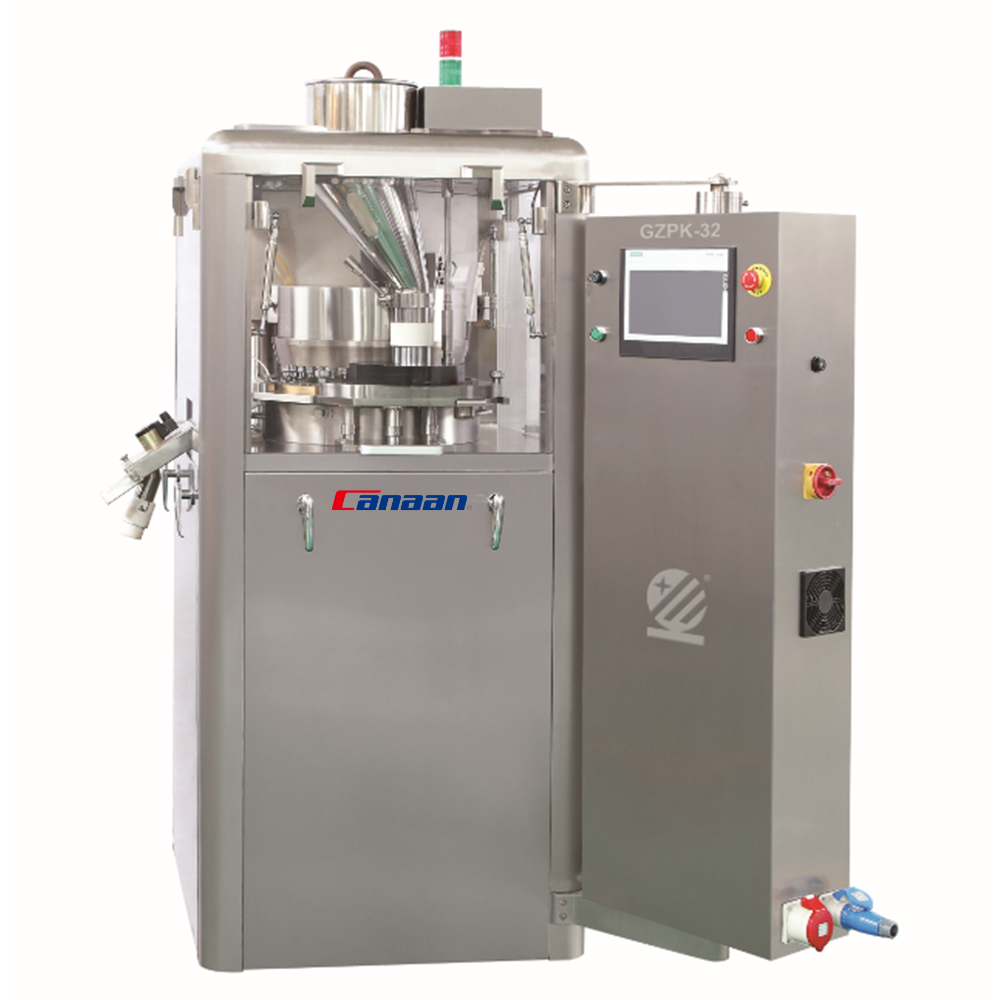
Canaan’s tablet press machines are precision-engineered to deliver exceptional performance for both R&D and production environments. These machines feature patented technologies that enhance efficiency and quality, ensuring superior output.
By applying precise pressure to compress the material into tablets, Canaan’s machines cater to various production scales and applications. Whether you’re looking for single-stroke, rotary, or multi-station presses, Canaan offers a solution tailored to your needs. Their advanced designs not only improve productivity but also ensure compliance with industry standards.
The rotary tablet press machine is a vital tool for industries requiring high-speed, precise, and cost-effective tablet production. Whether used as a high-capacity industrial machine or a cheap pill press machine for small-scale needs, its versatility and efficiency make it indispensable. By understanding its operation, advantages, and common issues, manufacturers can optimize their production processes and ensure consistent quality.

A rotary tablet press machine has versatile applications across multiple industries. Here are some of them:
Single-punch presses produce one tablet at a time, making them suitable for small-scale production or R&D purposes. In contrast, rotary tablet presses feature multiple tooling stations for high-speed, continuous production.
Routine maintenance includes cleaning after each use, inspecting for worn parts, lubricating moving components, and calibrating settings to ensure consistent operation.
Yes, affordable options like cheap pill press machines make rotary tablet presses accessible for small-scale operations and research labs.

Ready to Boost Your Production? Discover Canaan’s Rotary Tablet Press Machines Today!


Batch-to-batch variability and low tablet production yields remain persistent challenges in solid dosage manufacturing. When inconsistencies arise, manufacturers often focus on excipient selection or process parameter adjustments. In many cases, the underlying issue is in the selection of the granulation process itself. This article explores Canaan’s granulation solutions for different material characteristics and process requirements, […]
Quick Answer Continuous manufacturing pharmaceutical systems merge blending, granulation, and compression into one unbroken line to meet GMP compliance under 21 CFR Part 11. These lines run in-line, real-time quality monitoring instead of end-of-batch testing, typically handling 5 to 40 kg per hour. Canaan’s integrated pharmaceutical continuous manufacturing lines are built to meet these standards, […]
Quick Answer Cleaning validation in pharmaceutical manufacturing is the documented proof that equipment meets a set residue limit every time. A validated wash runs pre-rinse, detergent wash, rinse, and dry stages under fixed time, temperature, and pressure parameters. Canaan’s QD Series washing stations combine automated washing and drying in one controlled cycle, with key process […]
 +86-577-67378828
 canaan@chinacanaan.com